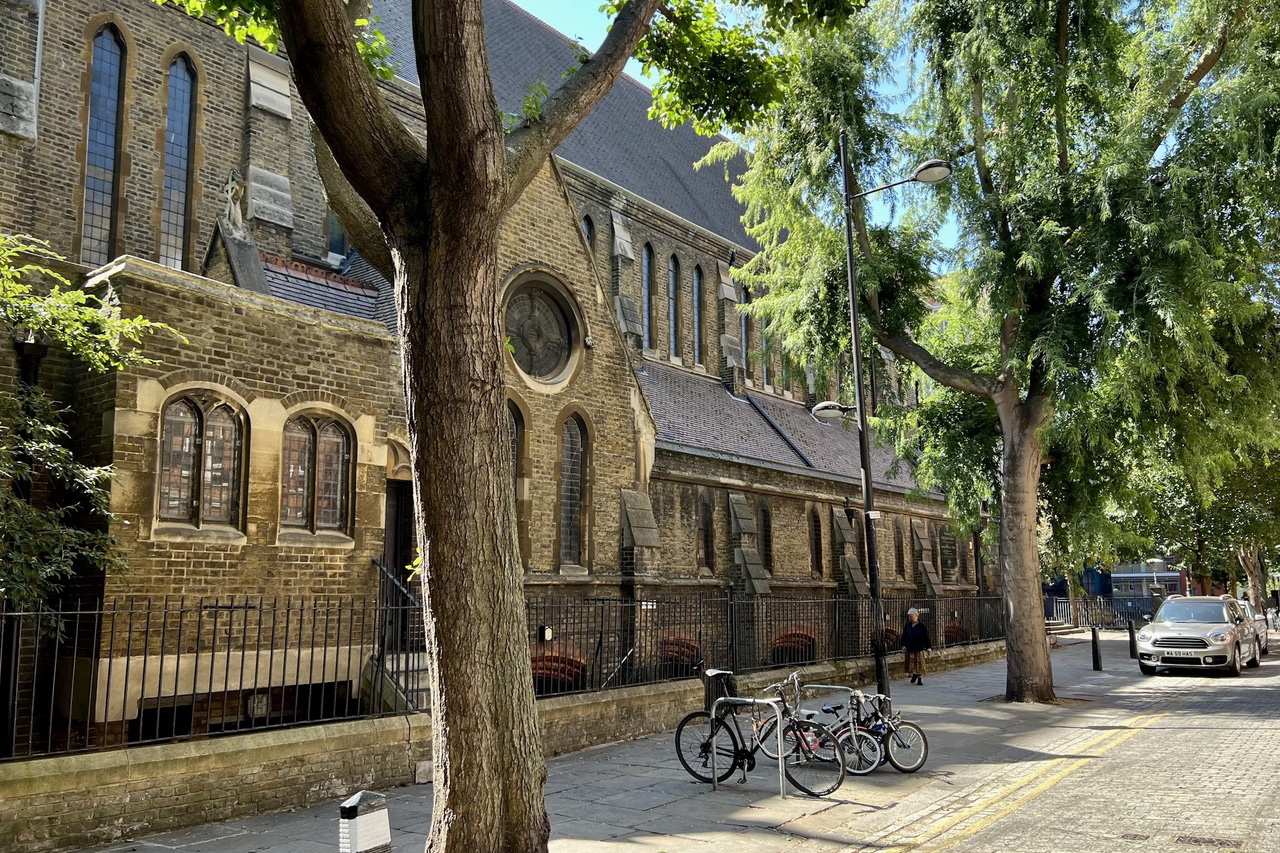
Ship of Fools: Church of the Holy Cross, King’s Cross, London, England


imageShip of Fools: Church of the Holy Cross, King’s Cross, London, England

Receiving communion in a circle around the altar in a small but committed parish church

Read the full Mystery Worshipper report here


Comments

  • Terry TeeTerry Tee Shipmate Posts: 25
    Communion in a circle is all very well, but it assumes that everybody will be receiving. For many different reasons there may be somebody who does not wish to communicate. I think it is still the official CoE position that you should be baptised to receive communion. In the Episcopal Church USA many celebrants issue an open invitation to 'anyone wherever you are on your faith journey'. Which rather whips away any doctrinal content from the eucharist.
  • SpikeSpike Ecclesiantics & MW Host, Admin Emeritus
    Terry Tee wrote: »
    Communion in a circle is all very well, but it assumes that everybody will be receiving. For many different reasons there may be somebody who does not wish to communicate.

    Why is it any different from people standing or kneeling in a line?
  • Bishops FingerBishops Finger Shipmate
    edited August 25
    Given the layout of this particular church (fixed pews) it is presumably possible for people who do not wish to receive to remain in their seat(s).

    Those standing around the altar would have had to move from their seats in order to get there IYSWIM, which they would also have had to do in order to get to a communion-rail or line, as the case may be.

    If the whole Mass were to take place around the altar, that would introduce different dynamics.
  • But one still has the option of simply crossing one's arms across the chest, which people who cannot, or do not wish to, receive commonly do.
  • angloidangloid Shipmate
    edited August 26
    Seems like my kind of church, and very similar to the one I normally attend. Especially the increase in the congregation during the first few minutes.

    Re Terry Tee's comment that open communion 'rather whips away any doctrinal content from the eucharist,' I don't see how that follows. When Jesus was performing miracles he didn't expect everyone to believe that he was the Messiah, and he was happy to cure and feed people of every faith and none. I think God's love, and his presence in the Blessed Sacrament, is there for all, whatever boxes they tick or fail to tick. I always think of that verse of Fr Faber's, 'we make his love too narrow/ By false limits of our own.'

    However, there is no suggestion in that report that all were expected to, or did, receive.
  • Yes, I thought Holy Cross sounded very much like Our Place, too - though we have a slightly larger average attendance these days (30+ as opposed to the 20+ a year ago).

    I see from their website that the pews at Holy Cross are, in fact, movable benches, as ours are. That's not to say that they're easily moved, of course...I know whereof I speak.

    BTW, Holy Cross is not a Forward-in-Faith/Society parish, so I wonder if they use the Anglican rite, rather than the Roman rite so many A-C churches seem to go for these days.
  • Terry Tee wrote: »
    Communion in a circle is all very well, but it assumes that everybody will be receiving.
    Yes, as others have pointed out, I don’t think it necessarily assumes that. My experience in places where Communion is done in that way bears out that it’s not necessarily assumed.


  • SojournerSojourner Shipmate
    In my experience, likewise.
  • angloidangloid Shipmate
    Yes, I thought Holy Cross sounded very much like Our Place, too - though we have a slightly larger average attendance these days (30+ as opposed to the 20+ a year ago).

    I see from their website that the pews at Holy Cross are, in fact, movable benches, as ours are. That's not to say that they're easily moved, of course...I know whereof I speak.

    BTW, Holy Cross is not a Forward-in-Faith/Society parish, so I wonder if they use the Anglican rite, rather than the Roman rite so many A-C churches seem to go for these days.

    There are concentrations of AC parishes in some areas and many of those will be so-called 'traditionalist'. But in these parts I can think of only two churches that use the Roman rite; most Anglo-catholic inclined places use Common Worship.
  • Well, AFAIK most of the Society parishes in this Diocese use the Roman rite undiluted. Our Place has what I call the 'Mish-Mash Mass', combining RC bits (such as Confession and Creed) with Anglican bits (the sung parts, and the Eucharistic Prayer).

    I agree that usage does vary from place to place.

  • angloidangloid Shipmate
    Well, AFAIK most of the Society parishes in this Diocese use the Roman rite undiluted. Our Place has what I call the 'Mish-Mash Mass', combining RC bits (such as Confession and Creed) with Anglican bits (the sung parts, and the Eucharistic Prayer).

    I agree that usage does vary from place to place.

    Not many 'Society' parishes in this diocese. One of them at least seems to use a very archaic mix of BCP and English Missal. At least they are recognisably Anglican, albeit eccentrically so. Another is 'modern Catholic', though whether that means CW with Roman trimmings, or full on RC, I'm not sure, but I guess the former.
  • PomonaPomona Shipmate
    Yes, it's not a given that Society churches will use the Roman rite.

    Personally speaking from an autistic point of view, I dislike any part of a service done in the round as it feels too exposing. The Eucharist is a very intimate thing, I appreciate the privacy of at least being able to have my back to other congregants.
  • Pomona wrote: »
    Personally speaking from an autistic point of view, I dislike any part of a service done in the round as it feels too exposing. The Eucharist is a very intimate thing, . . . .
    That’s the tension, I think. The Eucharist is intimate, but it is also communal, a communal meal to be precise. Speaking personally from my viewpoint, the communal aspect is the more important one—our communion is not just with God but with one another—and intimacy happens within that broader communal context.


  • Nick Tamen wrote: »
    our communion is not just with God but with one another
    I once heard it preached in a sermon that the Lord's Prayer does not say "give me today my daily bread," but rather "give us . . . ."
  • Pomona wrote: »
    Yes, it's not a given that Society churches will use the Roman rite.
    <snip>

    Fair point - I was over-generalising.
    :wink:
  • angloidangloid Shipmate
    Pomona wrote: »
    Yes, it's not a given that Society churches will use the Roman rite.
    <snip>

    Fair point - I was over-generalising.
    :wink:

    Possibly based on experience? There are whole swathes of the country that appear to be dominated by 'Society' parishes who use the Roman rite. Other regions differ.
    Also, it is not a given that a clearly 'anglo-catholic' church will be anti OoW or signed up to the 'Society'.
  • angloid wrote: »
    Pomona wrote: »
    Yes, it's not a given that Society churches will use the Roman rite.
    <snip>

    Fair point - I was over-generalising.
    :wink:

    Possibly based on experience? There are whole swathes of the country that appear to be dominated by 'Society' parishes who use the Roman rite. Other regions differ.
    Also, it is not a given that a clearly 'anglo-catholic' church will be anti OoW or signed up to the 'Society'.

    That is indeed so. The Society churches in this Diocese known to me personally mostly use the Roman Rite.
  • Terry TeeTerry Tee Shipmate Posts: 25
    To my respondents above: to stay in your pew does not make a statement, or does so discreetly. To cross your arms in full view of a circle does make a statement. As regards doctrinal content and open communion, what does it say if an atheist receives communion? Or someone from another religion? It says that faith in the living presence does not matter, what counts is the social gesture. It says you can still receive holy communion even though you reject Jesus as the Messiah and also the whole concept of sacrament.
  • Jesus, whether in the Blessed Sacrament or elsewhere, is quite capable of looking after himself, and accepting social gestures. His grace is sufficient to deal with the situations you rail against, and it is hardly your place to judge how and why people behave.

    God knows their mind - you don't.
  • angloidangloid Shipmate
    Jesus, whether in the Blessed Sacrament or elsewhere, is quite capable of looking after himself, and accepting social gestures. His grace is sufficient to deal with the situations you rail against, and it is hardly your place to judge how and why people behave.

    God knows their mind - you don't.

    Well said.
  • Alan29Alan29 Shipmate
    angloid wrote: »
    Pomona wrote: »
    Yes, it's not a given that Society churches will use the Roman rite.
    <snip>

    Fair point - I was over-generalising.
    :wink:

    Possibly based on experience? There are whole swathes of the country that appear to be dominated by 'Society' parishes who use the Roman rite. Other regions differ.
    Also, it is not a given that a clearly 'anglo-catholic' church will be anti OoW or signed up to the 'Society'.

    That is indeed so. The Society churches in this Diocese known to me personally mostly use the Roman Rite.

    That would be with the permission of both the Anglican and Catholic bishops, presumably.
  • You may think that. I couldn't possibly comment.
  • angloidangloid Shipmate
    Alan29 wrote: »
    angloid wrote: »
    Pomona wrote: »
    Yes, it's not a given that Society churches will use the Roman rite.
    <snip>

    Fair point - I was over-generalising.
    :wink:

    Possibly based on experience? There are whole swathes of the country that appear to be dominated by 'Society' parishes who use the Roman rite. Other regions differ.
    Also, it is not a given that a clearly 'anglo-catholic' church will be anti OoW or signed up to the 'Society'.

    That is indeed so. The Society churches in this Diocese known to me personally mostly use the Roman Rite.

    That would be with the permission of both the Anglican and Catholic bishops, presumably.

    Interesting. The Anglican bishops providing 'extended episcopal oversight', aka Flying Bishops, probably approve. Their diocesans no doubt shrug their shoulders helplessly. As for their Catholic counterparts, it would seem a matter of courtesy to ask them if another denomination wishes to use their liturgy (and hence, in some peoples' eyes, to masquerade as something they are not). But I don't know what the legal position is: does it count as a breach of copyright or not? Is the Church subject to the Performing Rights Act?
  • Alan29Alan29 Shipmate
    As a Catholic I find it deeply problematic from the point of ecclesiology (how a denomination worships is an expression of its core values and identity) and struggle to imagine what they think they are doing. It goes way beyond copyright and has plenty to do with respecting the Liturgy and spiritual ethos of other Churches and ones own Church. And at a gut level my reaction is "Hands off! How dare you!"
  • angloidangloid Shipmate
    Alan29 wrote: »
    As a Catholic I find it deeply problematic from the point of ecclesiology (how a denomination worships is an expression of its core values and identity) and struggle to imagine what they think they are doing. It goes way beyond copyright and has plenty to do with respecting the Liturgy and spiritual ethos of other Churches and ones own Church. And at a gut level my reaction is "Hands off! How dare you!"

    A the risk of taking this discussion off topic and probably into the realms of Purgatory, as an Anglican I agree with you. I wouldn't be an Anglican if I didn't believe that the C of E and related churches are fully part of the Catholic Church, and yearn for the re-uniting of all separated parts of that Church – naturally, it seems to me, under the leadership of the Pope. As part of the same family we speak the same language but in different dialects, and our liturgies are different variants of the same thing.

    But just as Roman Catholic worship has been influenced by the vernacular worship of other traditions, and things like the Charismatic Movement, so Anglicans and other Christians have been influenced by RC tradition. Much recent liturgical development has been ecumenical, and official C of E liturgy now embodies many texts and practices from the Catholic Church, notably the Holy Week rites. I assume, but I don't know, that some sort of courteous request was made by our liturgists to their counterparts across the Tiber.

    Anglicans who don't appear to want to be Anglican are another matter.
  • Most Christians,particularly those who identify as members of the historical groupings like RC,Orthodox,Anglican,Lutheran and even Presbyterian are much closer to one another than some people think.
    Yes,there was a time many decades ago when at least in RC churches in UK no 'Protestant' hymns would have been sung. With a great rise post Vatican2 in hymn singing in RC churches many hymns are now sung from many different sources.

    (This was not the same in German speaking lands where hymns for centuries have been shared over the religious divides)

    I think,although I do not know that the Lectionary,used by many religious groups, is much the same as that used by the RC Church and many religious communities can feel that it is 'their' lectionary.

    Personally I have no objection to Anglicans using RC rites though it would be nice for them to acknowledge it.

    However we all believe ? in 'one,holy,catholic and apostolic church'.
    We just understand differently the meaning of these words.
  • So many Protestant churches I've been to substitute "holy Christian church" for "catholic" -- but if they use "catholic" it's always with a small "c".

    I never understood why no one to my knowledge ever says "holy universal church".
  • /tangent alert/

    Whatever the doctrinal similarities or differences may be, it always seems to me that for a C of E parish to use the Roman Rite shows a contempt for the rules (Canon law) of the church, and a belief maybe that Rome is, or somehow knows, better.

    If a parish feels it must use someone else's liturgy, why not go for a denomination with which the C of E is in full communion, such as a Porvoo (Lutheran) church?

    https://porvoocommunion.org/
  • As an aside, at an ecumenical conference some Orthodox muttered about an Anglican clergyperson who did all the 'Orthodox' things during the Orthodox Liturgy and who crossed themselves, prostrated and so on in an Orthodox fashion.

    They felt it was 'cultural appropriation' to an extent and their reaction was similar to that expressed by @Alan29.

    I wasn't Orthodox at the time and observed that they didn't appear to object to me crossing myself in the Orthodox fashion and making Orthodox 'gestures' and so on.

    'Ah, but with you it's authentic,' they said.

    I wondered how they could tell.

    I do think there is a difference between influence across theological/denominational boundaries - Protestant hymns in RC Masses, the adoption of some RC practices by Anglicans during Holy Week etc - and deliberately setting out to steal or ape someone else's practices. I don't have any objection to other Christians using prayer-ropes or saying the Jesus Prayer or introducing icons to their church buildings, for instance.

    A lot depends on whether these things are 'organic' or done in a self-conscious kind of way.
    I've got to be honest, much as I admire Anglo-Catholicism I do think some practitioners try to 'pretend' that the Anglican communion as a whole is more 'Catholic' than it actually is - but Shipmates may disagree with me on that one.

    All that aside, I think we have to take whatever we encounter on its own terms in whatever setting it happens to be.

  • angloidangloid Shipmate
    much as I admire Anglo-Catholicism I do think some practitioners try to 'pretend' that the Anglican communion as a whole is more 'Catholic' than it actually is - but Shipmates may disagree with me on that one.

    It's not so much that I think, but just as certain types of Christian will dismiss others for not being truly Christian, so a certain type of Anglo-catholic will dismiss everyone who doesn't conform to their (highly eccentric and minority) version of Catholicism as beyond the pale. This will include the vast majority of Anglicans of all stripes, as well as, probably, most Roman Catholics whom they prefer to keep at a mysterious distance.

    A former director of the Anglican Centre in Rome remarked to me that very few of those who participated in their courses and events were traditionalist Anglo-catholics. Maybe because it would have brought them uncomfortably near the real thing.

    Or maybe I am getting too tendentious and uncharitable.
  • angloid wrote: »
    certain types of Christian will dismiss others for not being truly Christian,
    There are so many churches that claim to be the One True Church. I am always mindful of Queen Elizabeth I's paraphrase of Ephesians 4:5 -- "There is only one Christ, Jesus, one faith, all else is a dispute over trifles."
  • PomonaPomona Shipmate
    /tangent alert/

    Whatever the doctrinal similarities or differences may be, it always seems to me that for a C of E parish to use the Roman Rite shows a contempt for the rules (Canon law) of the church, and a belief maybe that Rome is, or somehow knows, better.

    If a parish feels it must use someone else's liturgy, why not go for a denomination with which the C of E is in full communion, such as a Porvoo (Lutheran) church?

    https://porvoocommunion.org/

    Because they don't consider those churches to be truly authoritative in the same way that Rome is. Likely they would not even recognise such a communion.
  • Pomona wrote: »
    /tangent alert/

    Whatever the doctrinal similarities or differences may be, it always seems to me that for a C of E parish to use the Roman Rite shows a contempt for the rules (Canon law) of the church, and a belief maybe that Rome is, or somehow knows, better.

    If a parish feels it must use someone else's liturgy, why not go for a denomination with which the C of E is in full communion, such as a Porvoo (Lutheran) church?

    https://porvoocommunion.org/

    Because they don't consider those churches to be truly authoritative in the same way that Rome is. Likely they would not even recognise such a communion.

    It was a rhetorical question, but ISWYM, and you may well be right.
Sign In or Register to comment.