Ship of Fools: Blessed Sacrament, Seattle, Washington, USA
 The Mystery Worshipper
Shipmate
The Mystery Worshipper
Shipmate
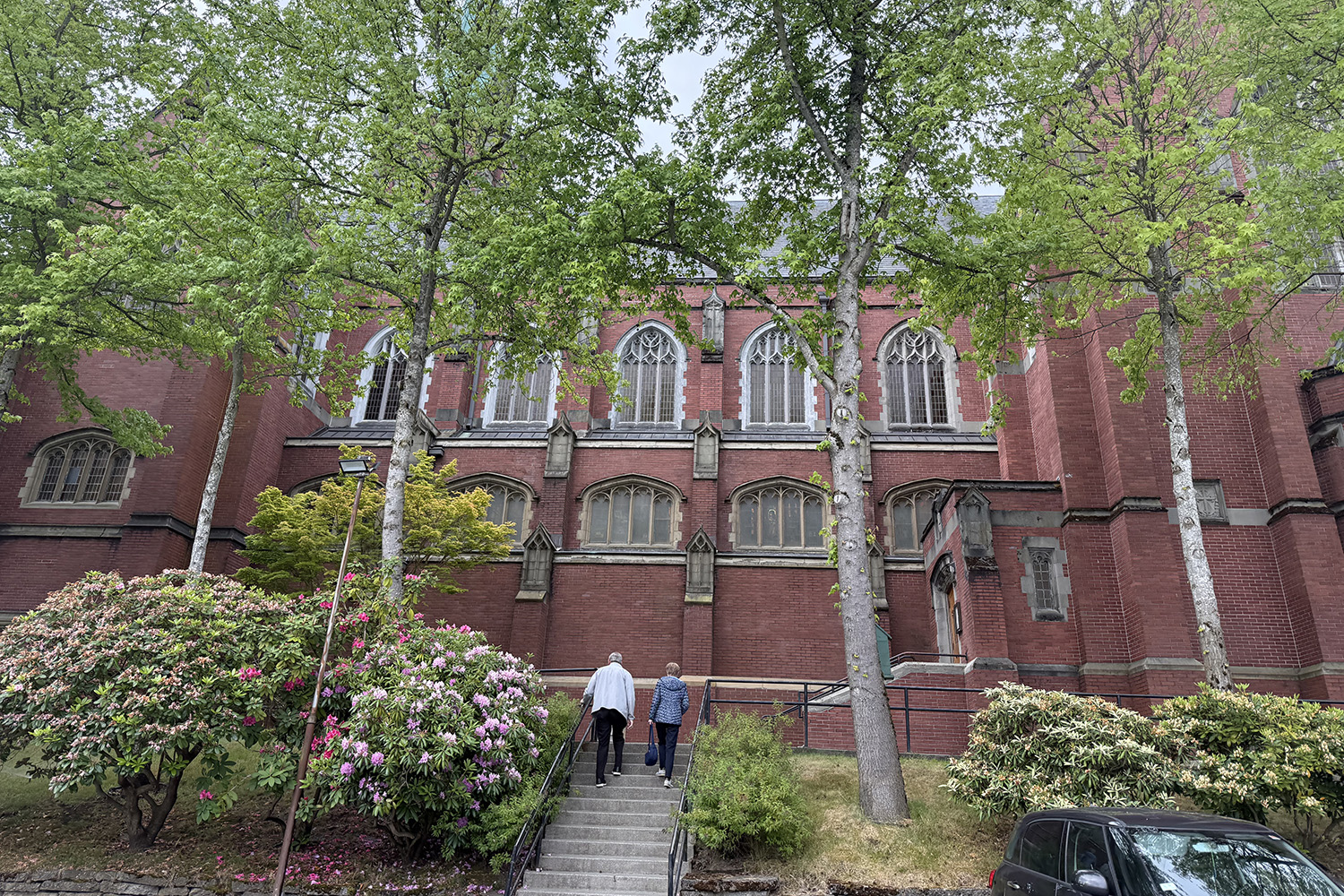 Ship of Fools: Blessed Sacrament, Seattle, Washington, USA
No one even glanced at the Mystery Worshipper, except for the Virgin Mary holding Jesus.
Read the full Mystery Worshipper report here
Comments
Were the mystery doors confessionals -- oops, I mean reconciliation rooms?
Sometimes these reports say more abour the worshipper than the service. This is one of those.
In other words it doesn't matter how 'bad' or 'good' it is, it is still the Mass, still the Body and Blood of Christ.
I'm sure the Mystery Worshipper could have visited an RC service elsewhere and been noticed, made welcome etc. It's not as if the RCC is monolithic in terms of its service styles and demographics.
I enjoy the Mystery Worshipper reports but often they reveal the author's own predilections. That's fine as long as they are acknowledged. This report seems to expect this particular service to conform to the author's own expectations of what 'should' take place rather than whatever does take place in that particular setting.
It would be rather like a Mystery Worshipper attending a Pentecostal service and being surprised that people were clapping or speaking in tongues, or a Quaker meeting and being shocked that people sat around quietly in a circle.
The doors are intriguing. Given that they have nameplates, I wonder if they lead to offices, or something of the sort.
Well, the MWer did say: and
My thought was the MW report betrayed an unfamiliarity with what a weekday morning Mass is often like compared with a Sunday Mass. my experience is weekday morning Masses generally don’t include music, rarely have greeters or the like, and are less likely to involve much interaction between worshippers than Sunday Masses are. I suspect there’s a sense that anyone there at 7:30 on a Monday morning is likely a faithful Catholic for whom everything is familiar, not a visitor. And there’s also probably a sense that everyone needs to get on with their day, so there’s not time for chit chat.
I think that anyone attending any church service, whether MWing or not, expects that the service will bring them close to God. Whether or not the particular service in question did is, I think, a reasonable matter for comment.
Familiarity, or lack thereof, with the traditions of the denomination holding the service will, of course, affect the worshipper's ability to feel this closeness.
Perhaps, but the MWer said:
All the doors were adorned with a black metal name plate with the names of different priests and important workers.
My italics. It's not clear how the MWer established that some of the names were those of 'important workers', though.
If only!
For sure.
I'm also not clear as to where these doors actually are. The word 'sanctuary' is IIRC sometimes used in the US to describe the church worship space as a whole, whereas many of us in the UK would think of it as describing the chancel, or the area immediately adjacent to the altar.
If the Doors of Mystery are situated within the nave, perhaps along the aisles thereof, they may well be confessionals or offices - but if they are in the chancel, what then?
I was a little thrown by there being 10 doors, thinking 10 confessionals seemed like a lot. But then I realized each confessional might have two doors—one for the priest and one for the penitent. Perhaps the doors for those confessing had something on them that appeared to be “important workers”?
I have always seen "sanctuary" in the Catholic church to mean the chancel, but in Protestant churches the entire worship space.
Order of Preachers though the MWer didn;t think much of their preaching.
I'm not sure they were being ironic either when they related how they wanted a 'sign' and somehow found it when the Madonna's eyes followed them around the room.
One minute they find all the Catholic stuff creepy and secretive, the next they're engaging in folk-religious practice themselves.
Sure, I get the impression that the icons are looking at me at every Orthodox service I attend. As 'windows into heaven' I presume they can be looked 'out of' as well as 'into'. But as for 'where is God in all this?' Well, the Almighty is meant to be omnipresent so I imagine he will have been around somewhere even if the Mystery Worshipper wasn't aware of it.
I agree that the lack of any greeting or human interaction was unfortunate but as @Nick Tamen points out, it would probably be assumed that anyone attending at that early hour would be a regular or a devout RC visor who knew the ropes.
I think @Amanda B Reckondwyth makes an important point that MW-ers should question whether or not a service brings them closer to God or not.
But there can be a whole range of factors at play there. Familiarity or unfamiliarity can work both ways.
The MWer is of course entitled to tell us exactly what he or she felt during the visit to the above church.
FWIW, I'm rather pleased they found some kind of hope/'redemption' in the icon that they hadn't found elsewhere in the service.
I may well have felt the same had I been the MW-er, I don't know. In my own setting I often find 'one thing' that might speak to me in a service whilst the rest seems to pass me be.
It might be a particular prayer or a verse from the epistle or Gospel reading, or a particular icon or something someone says over a cuppa afterwards - or any one of dozens of things that might potentially engage or disengage me.
I'm not saying the MW-er was 'wrong' - they are entitled to their perceptions and reactions.
All I was saying was that I found it gently ironic that they gained some kind of succour from a very Catholic item/practice when they clearly demonstrated a degree of suspicion/wariness of Catholicism in general elsewhere in their report.
Heck, I would probably harbour a degree of wariness when encountering an unfamiliar Christian tradition - or even revisiting one I was thoroughly familiar with.
My criticism of the MW report are mild. The MW-er has to be allowed to speak as they find and they have done so. All I am saying is that a wee bit more homework may have helped them to appreciate the context a bit more - as @Nick Tamen has indicated upthread.
Was the MWer able to hear the Readings (from the Apostle Paul,from Psalm 33 and from the Gospel of Matthew) ?
What was so bad about the eucharistic part of the Mass ? surely the MWer has attended services before where one has to listen to what is being said?
If the words and actions were not the sort of thing that the MWer is used to why was this not said ?
At least the MWer has told us what he or she did not understand about the homily or sermon but why not tell us more about the service in general ?
'It should be done the way I'm used to, the way it's done in my church ...'
I wouldn't have an issue if they'd written, 'I'm used to communion services where they do X, Y or Z, so found this one hard to understand or appreciate...'
Instead they simply denounced it as 'bad' as if that were self-evident and needed no further explanation.
Could do better.
This is why I think this MW report tells us more about the author than it tells us about the actual service they attended.
'I'm not used to this. I don’t even understand the context, what's happening nor very much about the particular tradition involved save that it's creepy and has a murky past and clearly isn't what I'm accustomed to so I won't bother to do any background research but slag the whole thing off because it doesn't fit with my subjective view of how church services should be ...'
This one was fine on 'atmosphere' but light on what the MW-er objected to, other than it being 'funereal' and not what they were accustomed to.
Just suppose I wrote one about a visit to a service where they received communion from individual cups rather than a single chalice, what would be best?:
'It was terrible. They all drank from individual cups not from a single chalice...'
Or
'I'm used to everyone receiving communion from a single, common chalice. Here, they all received individually from separate cups. It's not how it's done in my own church but this part of the service was conducted with dignity and respect.'
That kind of approach shouldn't be difficult, surely?
Or
'We don't have musical accompaniment in our Orthodox services but here the piano supported the congregational singing very well ...'
Or not, as the case may be.
Rather than, 'They even had a bass guitar! How dare they?'
Heck, why not, 'I'm more used to lively and informal services so the dreary tone of this one came as something of a shock.'
At least that would tell us something more than, 'It was bad. I didn't like it.'
'I didn't like the coffee. It was instant and too cold.'
Rather than, 'I didn't like the coffee.'
Again, not difficult.
A few people simply saying “I wish there had been more detail” or “I wish more had been said about why they felt how they felt” I’d feedback I would take as constructive criticism.
But multiple posts that go on and on about the MWer’s shortcomings, including assumptions about the MWer, would likely have me deciding not to waste my time any more.
I wouldn't want the MWer to be so discouraged by the criticisms here as not to continue. There were good points such as the way they conveyed the 'atmosphere' as they found it - something I alluded to upthread.
I don't think anyone here wants them to stop Mystery Worshipping.
A few nips and tucks and all would be well.
I could have been more measured in some of my comments.
I'm a big softee but can be quite harsh in edits - something I need to apply to my own writing and posts.